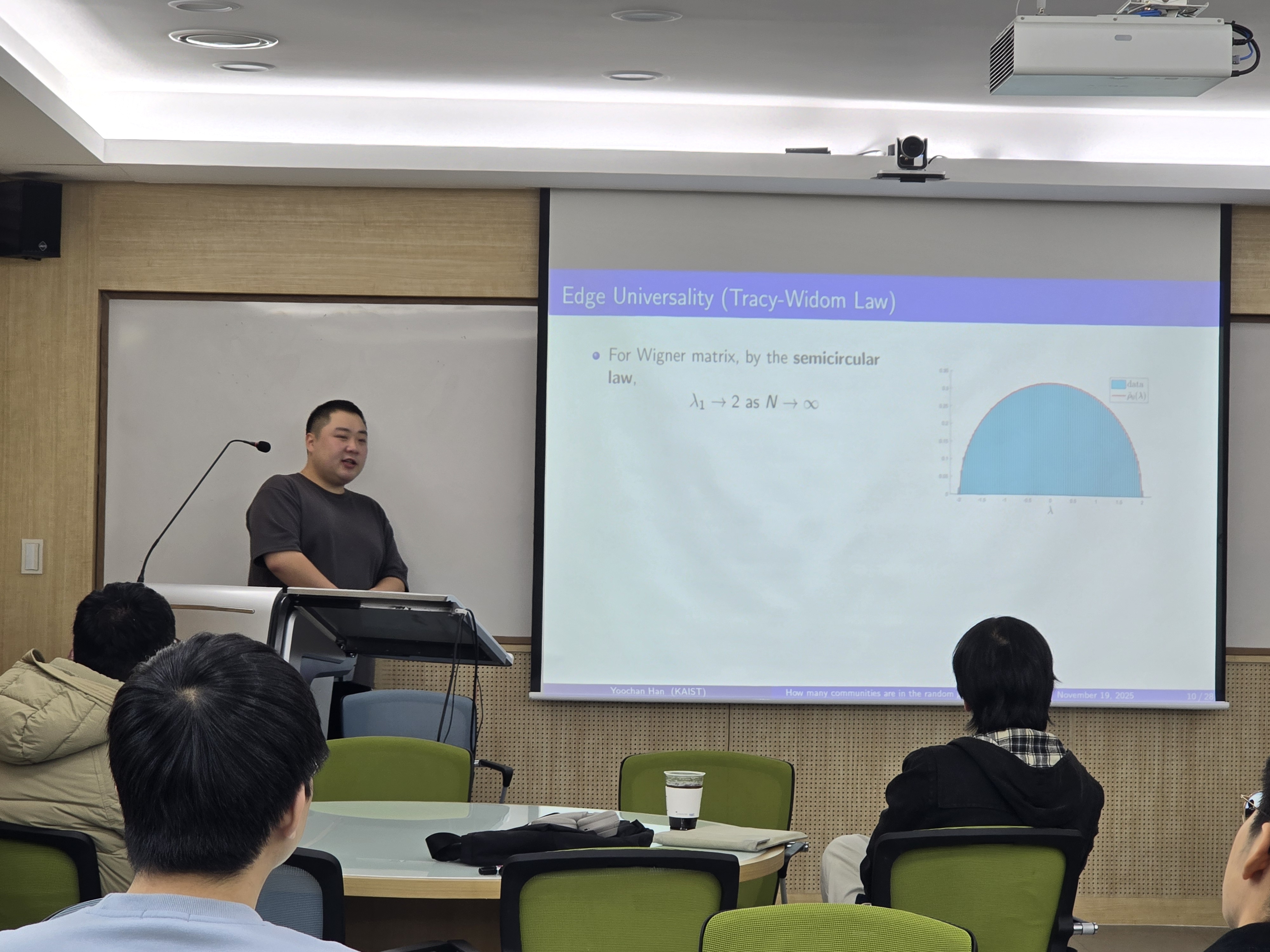
We uploaded photos from the 52th KMGS on Dec 04, 2025.
Thanks, Yoochan Han and all the participants!


KAIST Math Graduate Student Seminar (KMGS)
Department of Mathematical Sciences, KAIST
We uploaded photos from the 52th KMGS on Dec 04, 2025.
Thanks, Yoochan Han and all the participants!
The 52nd KMGS will be held on November 20, Thursday, at the Natural Science Building (E6-1) Room 1410. We invite a speaker Yoochan Han from the Dept. of Mathematical Sciences, KAIST.
The abstract of the talk is as follows.
[Speaker] 한유찬 (Yoochan Han) from Dept. of Mathematical Sciences, KAIST, supervised by Prof. 이지운 (Ji Oon Lee)
[Title] Spectral Properties and Weak Detection in Stochastic Block Models
[Discipline] Probability Theory
[Abstract]
In this talk, I will introduce basic ideas from random matrix theory and explain how spectral methods are used to study random graphs. Focusing on the stochastic block model, I will present recent results showing a sharp phase transition in the extreme eigenvalues and a central limit theorem for linear spectral statistics. These results lead to a simple spectral test for detecting the presence of communities. This talk is based on the joint work with Prof. Ji Oon Lee and Dr. Wooseok Yang.
[Language] Korean
We uploaded photos from the 51th KMGS on Nov 06, 2025.
Thanks, CHANYOUNG KIM and all the participants!


The 51st KMGS will be held on November 6, Thursday, at the Natural Science Building (E6-1) Room 1410. We invite a speaker Chanyoung Kim from the Dept. of Mathematical Sciences, KAIST.
The abstract of the talk is as follows.
[Speaker] 김찬영(Chanyoung Kim) from Dept. of Mathematical Sciences, KAIST, supervised by Prof. 하우석 (Wooseok Ha)
[Title] Quantum spectral operator learning for solving partial differential equations
[Discipline] Applied Mathematics
[Abstract]
Partial differential equations (PDEs) are central to modeling physical and engineering systems. Operator learning approximates their solution operators, enabling fast inference after training across diverse problem instances and strong generalization. While recent advances have proposed unsupervised methods that mitigate the cost of data generation, classical neural network–based approaches remain computationally expensive for high-dimensional operators and fine-resolution problems. To address these challenges, we propose a quantum–classical hybrid framework for unsupervised spectral operator learning. Our approach predicts spectral coefficients using quantum circuits, with gate parameters mapped from PDE instances (e.g., forcing functions or PDE parameters) via a classical neural network. To improve efficiency and feasibility, we introduce a training objective that requires fewer measurement repetitions than standard variational quantum linear solvers (VQLS). With this, we design shallower circuits by replacing controlled-unitary gates with direct Pauli measurements, which in turn allows grouping of commuting measurement operators for further reduction in runtime. The objective also resolves the sign ambiguity inherent in standard VQLS and guarantees recovery of the correct solution sign for PDEs. Overall, our framework reduces the computational cost and improves solution accuracy of VQLS, while also demonstrating the potential efficiency and scalability advantages of quantum operator learning over classical machine learning approaches. We validate our framework on one- and two-dimensional reaction–diffusion, Helmholtz, and convection–diffusion equations under diverse boundary conditions, achieving relative errors below 1%.
[Language] English